A diverse and international author and reviewer network
Real-World Impact
Research that advances theory and practice
Int. J. Adapt. Manag. Bus. Intell.
A global platform for research at the intersection of intelligent systems and data science.
Building robust, ethical, and scalable organizations requires an integrated approach that recognizes the close interdependence between adaptive management strategies and data-driven business intelligence. As global markets and operational environments become increasingly volatile, it is essential to move beyond static models and embrace systems that prioritize reliability, transparency, and long-term strategic sustainability.
IJAMBI focuses on methods that are resilient to market uncertainty and distributional shifts, specifically designing systems that allow businesses and institutions to adapt to evolving real-world conditions. Achieving meaningful progress in this field demands attention to foundational challenges such as data quality, predictive analytics, computational efficiency, and responsible deployment within corporate and governmental frameworks.
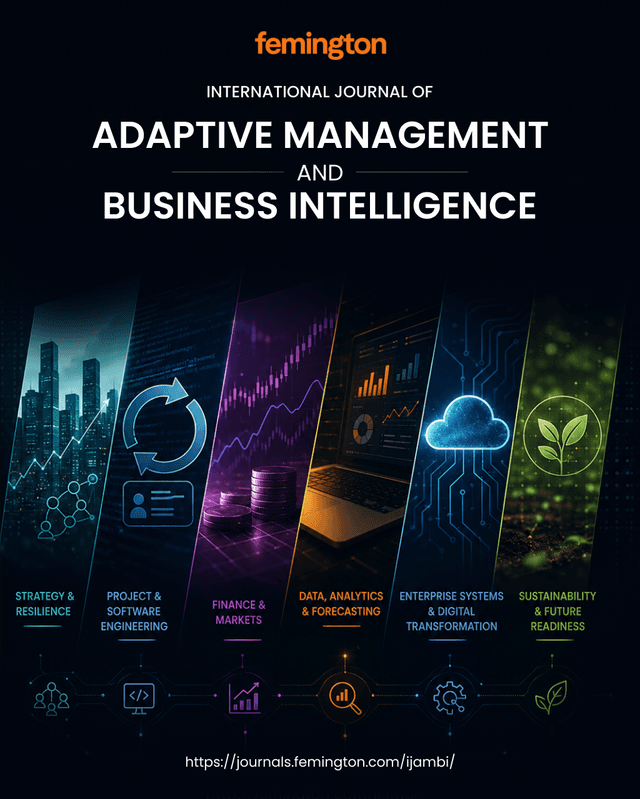
The International Journal of Adaptive Management and Business Intelligence (IJAMBI) provides a dedicated scholarly platform to advance these objectives. With a multidisciplinary focus, the journal brings together perspectives from management science, artificial intelligence, business analytics, and organizational theory to deepen understanding of how intelligent systems can be designed and applied to enhance human decision-making.
IJAMBI supports research that bridges the gap between theoretical frameworks and practical business applications, encouraging contributions that demonstrate both methodological rigor and real-world relevance. Through its editorial standards, the journal promotes reproducibility and ethical responsibility, recognizing the critical role that adaptive systems play in shaping resilient, competitive, and equitable futures.
Publisher: Who Supports This Journal?
The International Journal of Adaptive Management and Business Intelligence (IJAMBI) is published and supported by Femington, an independent academic publishing organization committed to advancing open, ethical, and high-quality scholarly communication. The journal is maintained using the Open Journal Systems (OJS) platform, an open-source publishing infrastructure widely adopted by academic institutions and journals worldwide.
By leveraging OJS, Femington ensures that IJAMBI operates on transparent, community-driven, and sustainable publishing principles. This enables efficient manuscript management, rigorous peer review, and long-term digital preservation, reinforcing the journal’s commitment to accessibility and academic integrity.
IJAMBI aims to make academic research available:
Online
Immediately upon publication
Free from most copyright or licensing restrictions
Accepted Types of Articles
IJAMBI considers the following categories of scholarly contributions:
Original Research / Research Articles:
Substantial and novel contributions presenting original theoretical developments in management, methodological innovations in business intelligence, or empirical analyses of adaptive systems. (6,000–8,000 words).
Review Articles:
Critical synthesis of existing research. This includes Critical Reviews of management literature, Systematic Reviews of business analytics trends, or Meta-Analyses of organizational performance data. (6,000–8,000 words).
Case Studies:
In-depth examinations of real-world implementations of adaptive management or BI solutions in corporate, governmental, or non-profit settings. (3,000–4,000 words).
Research Notes:
Concise manuscripts presenting preliminary findings, novel datasets, or emerging methodological ideas in business intelligence that warrant rapid communication. (2,000–3,000 words).
Editorials:
Commissioned pieces addressing topical issues or strategic directions relevant to adaptive management.
Aims and Scope
The rapid advancement of business intelligence and the increasing volatility of global markets have transformed organizational decision-making. These changes introduce critical challenges related to scalability, strategic robustness, and the ethical responsibility of automated and human-led systems.
The International Journal of Adaptive Management and Business Intelligence (IJAMBI) seeks to address these challenges by publishing research that advances the theoretical foundations and applied practices of intelligent management systems. The journal aims to foster innovation while encouraging critical reflection on the reliability and accountability of data-driven governance.
Principal areas covered include, but are not limited to:
Adaptive Management:
Agile leadership, change management, and resilient organizational architectures.
Business Intelligence & Analytics:
Predictive and prescriptive analytics, data mining for market insights, and real-time dashboarding.
Strategic Decision Support:
Recommender systems for executive decision-making and automated workflow optimization.
Data Governance & Ethics:
Privacy, transparency, and ethical AI in corporate environments.
Big Data in Management:
Scalable analytics and knowledge discovery in large-scale enterprises.
Interdisciplinary Applications:
BI in healthcare management, digital transformation in the public sector, and sustainable business models.
Benefits to Authors
All articles published in IJAMBI are fully open access. Key benefits include:
Flexible publication fees to ensure global inclusivity
Rigorous double-blind peer-review process
3143-7176ISSN
3 daysSubmission to first decision (median)
Continuous PublishingFrequency
CC BY 4.0License
Issue Details
Vol. 1 No. 2 (2026)
Published: July 28, 2026
This issue brings together a diverse collection of high-quality research spanning geospatial analytics, educational technology, financial systems, enterprise resource planning, supply chain resilience, business intelligence, and artificial intelligence. The featured articles present innovative frameworks, critical reviews, empirical investigations, and advanced analytical approaches that address contemporary challenges across academia and industry. By combining methodological rigour with practical relevance, these contributions offer valuable insights into data-driven decision-making, digital transformation, financial forecasting, and organisational resilience. Collectively, they highlight the expanding role of intelligent technologies and interdisciplinary research in shaping sustainable, efficient, and future-ready systems.
As organizations increasingly use machine learning in business process management, the need for transparent predictive models becomes critical. Predictive process monitoring (PPM) techniques deliver accurate forecasts of process outcomes
This paper discusses how business analytics capabilities can lead to innovation in digital commerce firms by turning data into actionable insights for strategic and operational decisions. By relying on secondary evidence published in articles, the findings analyze the use of descriptive, predictive, and
This paper explores the application of learning analytics in online educational environments to derive actionable insights from student-teacher interactions and digital learning activities. The proposed approach systematically utilizes techniques of data warehousing and data mining to collect, organize, process and analyze educational data generated by virtual learning
Bhargavi Ugandhar
September 2026 · Vol. 1 · Issue 3
CONTRIBUTE TO THE JOURNAL
Share research that moves medicine forward.
Submit original clinical research, systematic reviews, and evidence-led perspectives for rigorous peer review and global open-access readership.